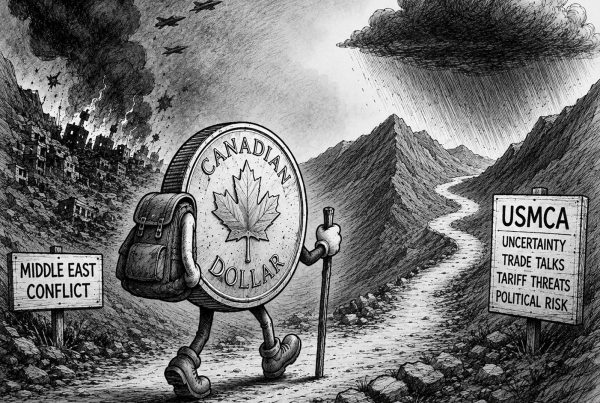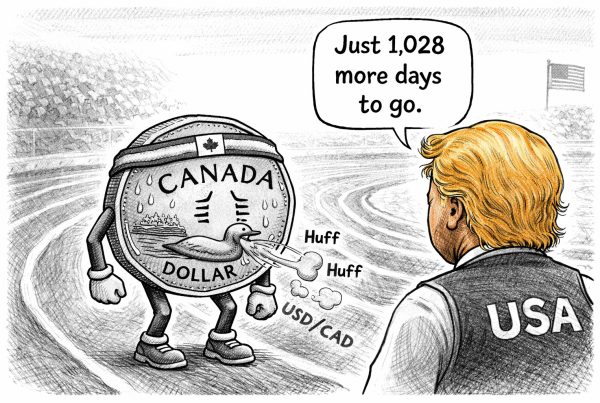

The Canadian dollar posted a strong week last week, though momentum briefly stalled on Monday as fresh U.S. tariff rhetoric rattled currency markets. This time, attention shifted to Canada’s trade relationship with China. While the headlines added noise and short-term volatility, investors largely shrugged off the threats from the White House. By Tuesday, the Canadian dollar continued to climb, gaining roughly three-quarters of a cent and extending its advance to nearly three cents over the past week.
Yes, the Loonie has been climbing. Yes, USD/CAD is trading near its lowest level since last summer. But the move says more about U.S. dollar weakness than renewed confidence in the Canadian economy. Perspective is still important. The Loonie has underperformed most major currencies so far this year. This move is less about Canada outperforming and more about the U.S. dollar underperforming.
The U.S. dollar has been under sustained pressure, with the dollar index sliding to its weakest level since early 2021. Capital has been rotating out of the greenback amid uncertainty around U.S. fiscal policy, growing questions about Federal Reserve independence, renewed political noise, and reports of coordinated U.S.–Japan efforts to support the yen. Add rising concerns about a potential U.S. government shutdown, and the backdrop for the dollar has clearly deteriorated.
Against that backdrop, the Canadian dollar has benefited by default. Still, it remains highly sensitive to political headlines. Even when tariffs fail to materialise, the uncertainty alone is enough to keep traders cautious, especially during a week packed with major central bank decisions.
The Bank of Canada is widely expected to keep interest rates unchanged. That outcome would surprise no one. What matters is tone. Policymakers are balancing persistent inflation pressures against slowing global growth and rising trade uncertainty. Any signal that the Bank is leaning more toward protecting growth than fighting inflation could temper the Canadian dollar’s recent gains.
South of the border, the setup is similar. The Federal Reserve is also expected to hold rates steady, but markets are far more focused on guidance than the decision itself. A heavy U.S. data calendar—including growth, inflation, labour market data, and consumer confidence—will shape expectations. Still, the larger issue remains confidence in U.S. policy direction.
From a technical standpoint, short-term indicators suggest the Canadian dollar’s recent advance may be stretched, leaving room for brief rebounds in USD/CAD. However, as long as U.S. dollar weakness persists, the broader bias remains lower. If momentum holds, last summer’s lows near 1.3537 move back into focus.
The Canadian dollar is currently trading at 1.36069 CAD against the US Dollar.