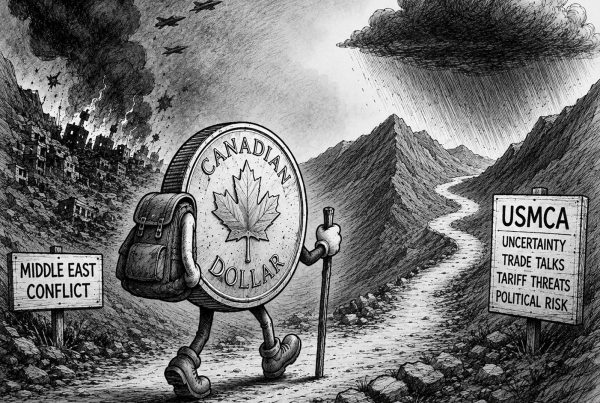

The Canadian dollar is weakening on Wednesday morning as markets react to a fresh wave of geopolitical headlines out of the Middle East. While optimism around potential peace talks has lifted global equities, currency markets are taking a more cautious approach and that’s keeping pressure on the loonie.
Reports that the U.S. has presented a 15-point proposal aimed at de-escalating tensions, along with signals from Iran that “non-hostile” ships can safely pass through the Strait of Hormuz, have helped calm immediate fears. Equity markets responded quickly, with stocks across Asia, Europe, and North America moving higher.
But in FX, the reaction has been far more measured.
Oil Drops, and So Does the Canadian Dollar
For the Canadian dollar, oil remains a key driver, and right now, oil is slipping.
Prices dropped roughly 4% overnight as geopolitical fears eased. While that may support broader risk sentiment, it creates a short-term headwind for Canada. As a major energy exporter, the Canadian dollar tends to move alongside oil prices, and that relationship is showing up clearly again.
The loonie has now lost more than a full cent since earlier this week, with USD/CAD climbing toward 1.3790 and touching fresh eight-week highs.
Strong U.S. Dollar Keeps Pressure on CAD
At the same time, the U.S. dollar continues to hold firm.
Despite improving global sentiment and a slight pullback in expectations for aggressive Federal Reserve rate hikes, the USD remains resilient. That tells you something important: currency markets are not fully convinced that risks have faded.
Conflicting headlines continue to emerge. While some reports point to progress toward negotiations, others suggest that Iran is not accepting ceasefire discussions and sees talks as not viable under current conditions.
That uncertainty is enough to keep traders cautious. When markets lean cautious, the U.S. dollar tends to benefit, while currencies like the Canadian dollar come under pressure.
Interest Rates Still in the Background
Beyond geopolitics, global interest rate expectations continue to shape currency moves.
The European Central Bank has kept the door open for another rate hike as soon as April, while U.K. inflation remains above target, keeping additional tightening on the table. In contrast, softer inflation data in Australia has reduced the urgency for further hikes there.
This uneven global backdrop continues to favour the U.S. dollar over the Canadian dollar.
Why the Canadian Dollar Feels Stuck
The Canadian dollar is currently caught in an unusual setup.
Typically, when global risk sentiment improves, the U.S. dollar weakens and the Canadian dollar strengthens, especially alongside stable or rising oil prices. But this time, that relationship is not holding.
Oil prices are falling, which is already a headwind for the Canadian dollar. At the same time, while equity markets are reacting positively to headlines around potential peace talks, currency markets are not fully buying into that optimism.
There is still a lack of confidence in the conflict ending anytime soon, with conflicting reports continuing to emerge. As a result, the U.S. dollar is holding firm instead of pulling back.
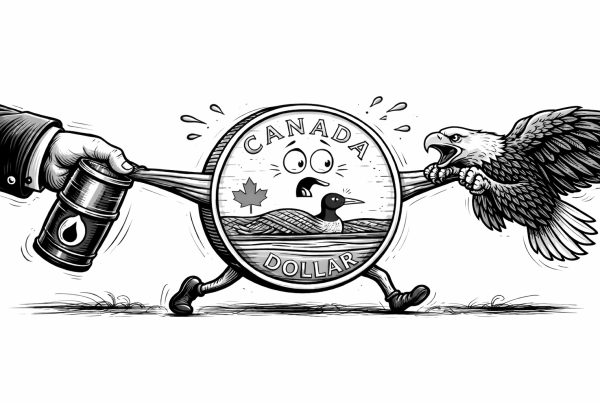
That leaves the Canadian dollar stuck on both sides—pressured by weaker oil and a resilient U.S. dollar, even as broader risk sentiment appears to improve.
Until there is more clarity and conviction around geopolitical developments, that dynamic is likely to keep the loonie on the back foot.
Canadian Dollar Levels to Watch
From a technical perspective, 1.3800 in USD/CAD remains the key level.
It is acting as firm resistance and sits close to the 200-day moving average. A sustained break above that level could open the door to a move toward 1.3850, followed by a potential test of 1.3900.
On the downside, a reversal would likely require a rebound in oil prices or a meaningful shift in geopolitical headlines.
What’s Next for the Canadian Dollar?
With little on the economic calendar, the Canadian dollar is being driven almost entirely by headlines.
If peace efforts gain traction and oil stabilizes, the loonie could recover. But if tensions escalate again, or if markets lose confidence in the current optimism, the U.S. dollar could extend its gains.
For now, the message from markets is clear.
The Canadian dollar is reacting to uncertainty, and until that uncertainty clears, the loonie is likely to remain under pressure.
The Canadian dollar is currently trading at 1.3793 CAD against the US Dollar.